
This is a sponsored guest post.
Best Parenting Books Every Parent Should Read in 2026
Many parents find their daily stress completely overwhelming. This collective pressure makes finding reliable guidance a regular necessity as families face toddler tantrums, screen-time discussions, emotional regulation challenges, and more. Looking for the best parenting books usually stems from a desire to navigate these exact moments and communication challenges. Parents search for clear, actionable methods that protect the parent-child relationship during high-stress transitions.
We put together this list after reviewing expert reading recommendations, parenting quotes, parenting organization guidelines, current bestseller data, and nonfiction books. Examining the resources alongside the Bookey app, which offers condensed summaries of popular parenting books, highlights a wide ecosystem of modern parenting learning resources and insights. Let’s see what books address your current family dynamic!
1. ‘The Whole-Brain Child’ by Daniel J. Siegel: Understand Daily Emotional Reactions
Children frequently experience intense emotional shifts during school transitions, moments of frustration, or typical sibling conflict. Daniel J. Siegel and Tina Payne Bryson explain these reactions through basic neurology, demonstrating how a child’s brain handles stress differently than an adult brain.
The authors use the concept of the upstairs brain, which handles logic and decision-making, and the downstairs brain, which governs basic survival instincts and raw emotions. During a meltdown, the downstairs brain takes complete control, making logical reasoning ineffective until the child feels safe.
Siegel suggests a core daily lesson for parents: connect before you correct. When your child is upset, you can match their non-verbal tone by kneeling down, offering a gentle touch, or validating their frustration. Taking this step helps soothe their overactive nervous system before you attempt to explain the rules or consequences.

Books on Parenting Collections by Topic Libraries: Parenting Research Becomes Easier to Follow Alongside Everyday Reading
Many parents consume critical developmental information in short intervals. Combining traditional full-length texts with structured topic summaries allows you to maintain consistency even during hectic weeks. You can use comprehensive books on parenting collections to help you quickly compare different behavioral philosophies. Busy schedules mean parents often read during brief breaks, school pickup waits, or standard evening routines.
The parenting topic library apps usually integrate into this approach by organizing core themes into manageable segments without requiring hours of free time. Accessing verified insights in a concise format helps you recall key strategies right when an unexpected tantrum occurs. This hybrid reading style ensures you stay connected to professional advice throughout the changing stages of childhood.
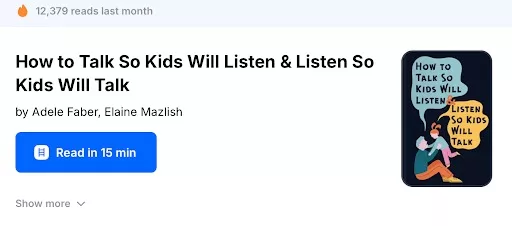
2. ‘How to Talk So Kids Will Listen’ by Adele Faber and Elaine Mazlish: Practical Conversation Scripts for Everyday Conflicts
Bedtime delays, teeth-brushing refusals, or general chore resistance often turn household routines into exhausting power struggles. Adele Faber and Elaine Mazlish address these everyday conversations at home by focusing on specific communication adjustments that prevent escalating arguments. The book provides direct conversation scripts that show how acknowledging a child’s feelings makes them far more cooperative.
Helping children express feelings requires moving away from dismissing their frustrations and moving toward descriptive language. For example, telling a child that a toy cleanup looks like a big job helps them feel understood. This simple shift encourages problem-solving because the child no longer feels defensive or ignored. Faber often incorporates a famous parenting quote into her philosophy, reminding readers that treating children with the same respect we show adults completely changes how they listen to us.
3. ‘No-Drama Discipline’ by Daniel J. Siegel and Tina Payne Bryson: Learn What Children Gain From Consequences
Discipline remains a consistent challenge, often causing parents to confuse temporary compliance with actual long-term learning. This text distinguishes between immediate punishment and intentional teaching, showing how harsh reactions often trigger defensive neurological loops. The authors provide a practical three-step framework to guide behavior effectively.
First, you connect by ensuring the child is calm and emotionally receptive before discussing the behavior. Second, you redirect by discussing the boundary clearly, focusing on what the child can do next time. Third, you repair the connection by engaging in a supportive conversation after the conflict to fully restore the relationship.
The core takeaway here is that discipline functions as a teaching tool. Focusing your energy on building emotional skills for the future works better than simply imposing a penalty for past mistakes. Consequences shape future behavior only when the child understands the relationship between their choices and the outcome.
4. ‘Hunt, Gather, Parent’ by Michaeleen Doucleff: Share Family Practices From Different Cultures
Michaeleen Doucleff begins her narrative with direct field observations of indigenous communities in Maya, Inuit, and Hadzbe cultures. These families maintain high levels of daily cooperation at home without relying on the continuous praise or punishment systems common in Western parenting. Children participate in daily household responsibilities naturally because they are included in adult tasks from an early age.
Many modern parents search for alternatives to reward systems, finding that stickers and charts often reduce intrinsic motivation. Anthropological reporting shows that treating children as helpful members of the household team reduces daily power struggles. This research-based study encourages parents to step back and let children contribute to family life at their own natural pace.
5. ‘The Montessori Toddler’ by Simone Davies: Help Parents Build Independence Earlier
Navigating the early toddler years requires an environment that honors a child’s natural desire for self-directed exploration. Simone Davies provides practical ways to implement traditional Montessori principles specifically for young children at home. Utilizing the best parenting books for toddlers helps you structure daily routines around self-directed learning and functional development.
Preparing home environments means organizing rooms so toddlers can access their own clothes, toys, and cleaning tools safely. Simple morning routines become smoother when a child can reach their own shoes and coat without waiting for adult assistance. This structural arrangement fosters early independence and significantly reduces daily frustration for everyone.
6. ‘Good Inside’ by Dr. Becky Kennedy: Focus on Connection During Difficult Parenting Moments
Parental guilt, personal frustration, and repeated daily conflicts often leave parents feeling disconnected from their children. Dr. Becky Kennedy introduces a framework built on the principle of internal goodness, asserting that both parents and children are doing the best they can with the emotional tools available. This perspective changes how you look at challenging behavior during stressful moments.
Dr. Becky reminds us that behavior functions as a direct form of communication. An outward emotional outburst is simply a visible sign of an internal skill that a child has not yet fully mastered. A relatable situation, like a child screaming in a grocery store, becomes an opportunity to address the underlying distress rather than simply stopping the noise. This practical framework helps parents regulate their own nervous systems before attempting to soothe a child.
7. ‘Siblings Without Rivalry’ by Adele Faber and Elaine Mazlish: Reduce Conflict Between Brothers and Sisters
Constant bickering, competition for parental attention, and toy disputes can disrupt the peace of any household. Adele Faber and Elaine Mazlish offer concrete solutions for managing complex family dynamics without causing resentment between siblings. The authors explain that comparing children, even through well-meaning praise, often creates unintentional rivalries.
Many readers appreciate the book’s practical examples and moments of parenting humor that reflect real family life. The book frequently addresses several common situations:
- Daily sharing issues and personal toy ownership disputes.
- Unspoken jealousy after the arrival of a new baby.
- Continuous family attention disputes during shared playtime.
9. ‘Raising Good Humans’ by Hunter Clarke-Fields: Bring Mindfulness Into Everyday Parenting Decisions
Parental stress often leads to automatic, reactive responses that escalate minor household accidents into major arguments. Hunter Clarke-Fields combines basic mindfulness techniques with clear communication strategies to help parents break these generational cycles. The research references studies from various medical institutions showing how emotional awareness reduces instances of explosive parenting.
A practical example is the five-minute pause technique, where a parent consciously stops to breathe before responding to a spilled glass or a broken rule. This intentional pause shifts your response from an angry reflex to a calm, boundary-setting conversation. Practicing regular emotional awareness creates a more peaceful home environment where children learn to regulate their own feelings by watching you.
Parenting Lessons Worth Revisiting Long After Finishing the Last Page
The books discussed provide clear strategies for managing the toddler years, improving communication, and establishing consistent discipline. Every family dynamic benefits from understanding how neurological development shapes a child’s outward behavior during stressful transitions. Implementing these methods creates a supportive environment where sibling relationships can thrive naturally over time.
Finding the right path through these best parenting books involves matching the author’s framework to your immediate family situation. Many parents combine full-length educational books with shorter summaries and microlearning formats to review core concepts throughout the busy year. Starting with a single title that directly addresses your current household challenge allows you to build a peaceful, connected home environment.
Related Posts:



Hi there! I am Emily Evert, the owner of Emily Reviews. I am 28 and live in a small town in Michigan with my boyfriend Ryan and our two pugs. I have a large family and I adore my nieces and nephews. I love reading memoirs, and learning about child development and psychology. I love watching The Game of Thrones, Teen Mom, Sister Wives and Veep. I like listening to Jason Isbell, John Prine, and other alt-country or Americana music. I created Emily Reviews as a creative outlet to share my life and the products that I love with others.
This post currently has no responses.



Leave a Reply