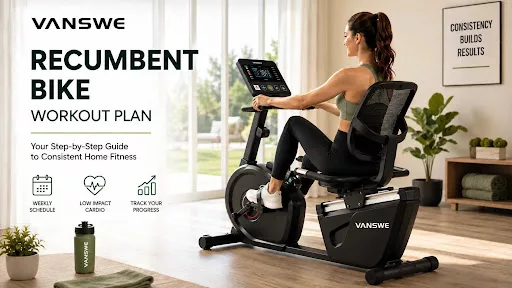
Building a home workout routine does not always require high-impact exercise or complicated fitness equipment. For people who prefer seated cardio, want more back support, or simply want an exercise machine that feels comfortable enough to use consistently, a recumbent exercise bike can be a practical addition to a home gym.
Unlike upright exercise bikes, recumbent bikes place the rider in a reclined seated position with the pedals positioned in front of the body. The larger seat and supportive backrest create a different riding experience from traditional stationary cycling.
However, not every recumbent bike is designed for the same type of user. Differences in seat design, resistance, weight capacity, dimensions, adjustment range, and additional features can significantly affect how comfortable and practical a bike feels at home.
Before buying one, it helps to understand which features actually matter.
Start With Rider Comfort and Fit
Comfort is one of the main reasons people consider recumbent cycling in the first place, so the seat should be one of the first things to evaluate.
Look at both the seat cushion and the backrest. A wider padded seat may be more comfortable during longer workouts, while a supportive backrest can help maintain a stable seated position.
Seat adjustment is equally important.
Most recumbent bikes allow the seat to move forward or backward to accommodate different leg lengths. When positioned correctly, the rider should be able to pedal through the full rotation without excessively stretching the legs or bringing the knees too close to the body.
If several people will share the bike, a broad adjustment range becomes even more valuable.
Manufacturers commonly provide recommended rider-height ranges, but these should be treated as a starting point rather than the only measurement. Leg length and individual proportions can affect fit as well.
Consider How Easy the Bike Is to Get On and Off
The frame design of a recumbent bike can make a surprisingly large difference in everyday use.
Many models use a step-through or walk-through frame that leaves an open area between the seat and the front console. Instead of lifting a leg over a high center frame, the rider can approach the seat more directly.
This can be particularly convenient for older adults, beginners, and anyone who simply prefers easier access to the seat.
When comparingrecumbent exercise bikes ,look beyond resistance levels and electronic features. Consider the entire process of using the machine—from approaching it and sitting down to adjusting the seat and beginning a workout.
A bike that is easy to use is more likely to become part of a regular routine.
Check the Weight Capacity and Frame Stability
Maximum user weight is another specification worth checking carefully.
Home recumbent bikes vary considerably in capacity. Some models are designed around lighter frames, while heavy-duty designs may support 300, 400 pounds, or more.
A higher weight rating can also indicate that the manufacturer has designed the frame for a wider range of riders, although weight capacity alone does not determine overall build quality.
Pay attention to the bike’s base, stabilizers, seat rail, and overall construction.
The goal is to find a bike that feels stable during normal pedaling rather than one that shifts or rocks as resistance increases.
Always choose a model with a stated maximum capacity comfortably above the intended rider’s weight and follow the manufacturer’s usage recommendations.
Choose the Right Resistance System
Resistance determines how easy or challenging pedaling feels.
Magnetic resistance is common in modern home exercise bikes because it can provide smooth resistance without relying on friction pads constantly contacting the flywheel.
Depending on the model, resistance may be controlled manually with a knob or electronically through the console.
Manual resistance is straightforward. Riders can turn a control to make pedaling easier or harder without navigating programs or menus.
Electronic resistance can be useful for people who want more structured workouts. Some bikes combine electronic resistance with preset programs that automatically create different workout patterns.
Neither system is automatically better.
Someone looking for simple daily cardio may prefer manual controls, while a rider who enjoys progressive workouts may appreciate electronic resistance and built-in programs.
Think About Noise in Your Home
Noise matters more at home than it does in a commercial gym.
A bike might be used in a bedroom, apartment, living room, or shared home gym. In those environments, a loud drivetrain can become frustrating for both the rider and other people nearby.
Magnetic resistance and belt-drive systems are popular choices for home cardio equipment because they can operate with relatively little mechanical noise.
This is especially useful for people who exercise early in the morning, late at night, or while watching television.
Remember that resistance is only one potential source of sound. Pedals, loose hardware, an unstable floor, and normal wear can also contribute to noise over time.
Measure Your Available Space Before Buying
Recumbent bikes tend to be longer than upright bikes because the pedals sit in front of the rider.
That makes floor space an important part of the buying decision.
Measure the area where the bike will actually be used rather than relying on visual estimates. Leave additional room around the machine so that the rider can comfortably get on and off.
Also consider how the bike will reach that location.
Doorways, hallways, stairs, and tight corners can matter when moving a large piece of fitness equipment into a home.
For smaller spaces, compact models and transport wheels can make placement easier. If the bike will regularly be moved between rooms, transport wheels may be more important than shaving an inch or two from its overall dimensions.
Decide Whether You Want Lower-Body or Full-Body Exercise
Traditional recumbent bikes primarily involve the lower body.
Pedaling works muscles including the quadriceps, hamstrings, calves, and glutes while providing cardiovascular exercise.
However, some recumbent bikes include moving arm handles or arm exercisers.
These designs allow the rider to move the arms and legs during the same workout. They can appeal to people who want more upper-body movement without switching to another machine.
The trade-off is that full-body models are often larger, more complex, or more expensive than basic lower-body bikes.
If seated cycling is your main priority, a traditional model may be all you need. If you specifically want coordinated upper- and lower-body movement, compare models with moving arms.
Don’t Pay for Features You Won’t Use
Exercise equipment increasingly includes Bluetooth connectivity, workout apps, heart-rate sensors, preset programs, large displays, and other technology.
These features can be useful—but only if they support the way you actually exercise.
A person who enjoys tracking workouts through an app may value Bluetooth connectivity. Someone who simply wants to pedal for 30 minutes while watching television may care much more about seat comfort, quiet operation, and simple resistance controls.
Before paying extra for technology, ask a simple question:
Will this feature make me more likely to use the bike consistently?
If the answer is no, prioritize comfort, fit, stability, and usability instead.
Compare Bikes Based on How You Will Actually Use Them
There is no single recumbent bike that is ideal for every home.
A senior looking for straightforward daily cardio may prioritize easy access and simple controls. Someone living in an apartment may care more about footprint and noise. A taller or heavier rider may put seat adjustment and frame capacity at the top of the list. Another user may specifically want moving arms or electronic workout programs.
This is why comparing several ** recumbent exercise bikes** can be more useful than choosing a bike based on one specification alone.
Start by identifying your top two or three priorities. Then compare models according to those needs.
A simple checklist can include:
Rider height and seat adjustment range
Maximum user weight
Seat and backrest design
Step-through access
Resistance type and number of levels
Overall footprint
Transport wheels
Noise considerations
Workout programs
Bluetooth or app connectivity
Moving arm handles, if desired
Warranty and customer support
This approach makes it easier to eliminate bikes that do not fit your needs before comparing smaller differences in price or features.
Consistency Matters More Than Complexity
The most advanced exercise bike is not necessarily the best one for a home gym.
A useful piece of home fitness equipment should fit the rider, fit the available space, and fit naturally into a regular routine.
For some people, that means electronic resistance and structured programs. For others, it means a comfortable seat, quiet magnetic resistance, and controls that take seconds to understand.
Recumbent cycling can provide a convenient way to add seated, low-impact cardio to a home fitness routine. Choosing the right bike comes down to understanding which features will make that routine comfortable enough and convenient enough to maintain.
Measure your space, check rider fit and weight capacity, compare resistance systems, and prioritize the features you will actually use.
The best recumbent exercise bike is ultimately the one you are comfortable returning to workout after workout.
Hi there! I am Emily Evert, the owner of Emily Reviews. I am 28 and live in a small town in Michigan with my boyfriend Ryan and our two pugs. I have a large family and I adore my nieces and nephews. I love reading memoirs, and learning about child development and psychology. I love watching The Game of Thrones, Teen Mom, Sister Wives and Veep. I like listening to Jason Isbell, John Prine, and other alt-country or Americana music. I created Emily Reviews as a creative outlet to share my life and the products that I love with others.







Leave a Reply